Reconstructing a Century of U.S. Corporate Bonds


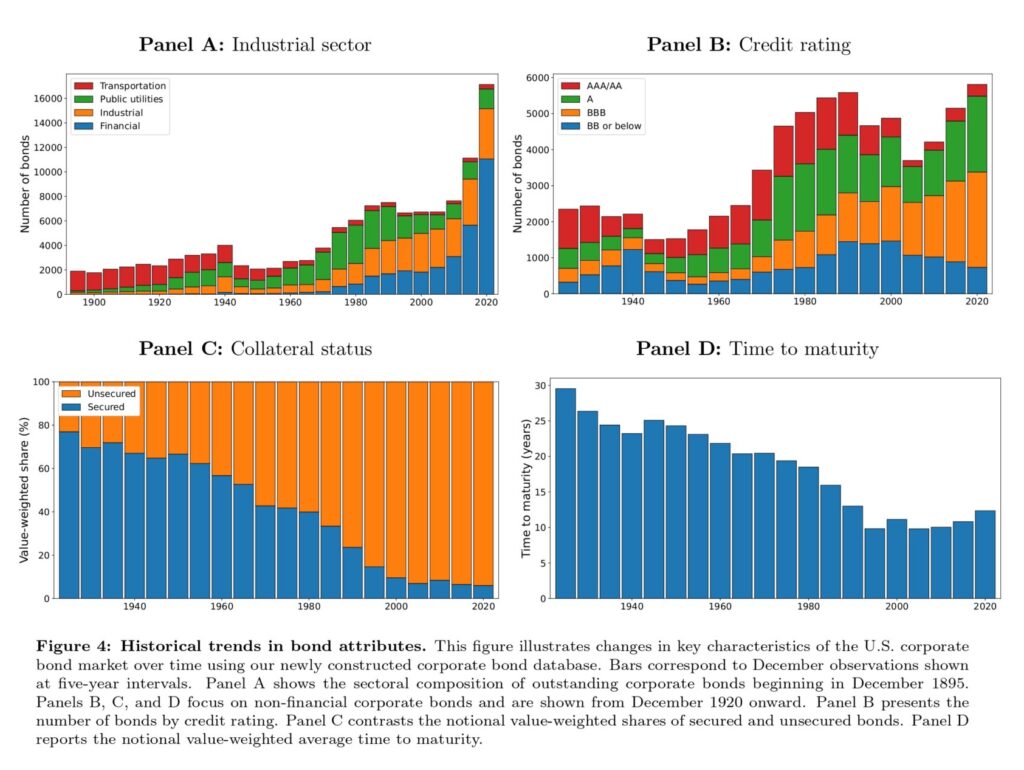
The authors build a new 128-year corporate bond database (1895–2022) — over 100,000 bonds and 7 million observations — by hand-collecting historical bond quotes from archival print sources and merging them with modern data.

Over this long sample, they find a sizable, statistically significant credit risk premium that survives controls for duration and interest rate risk — pushing back on recent work that attributes corporate bond returns mostly to the term premium. Notably, short samples fail to detect this; it only shows up with the century of data.

Credit spreads predict future bond returns and macroeconomic activity, but their power to forecast the business cycle weakens once prewar data and the Great Depression are added — suggesting the spread-economy link is time-varying.

Major equity factors (market, size, value) are also priced in corporate bonds over the long sample, supporting a common factor structure across stocks and bonds rather than segmented markets.

Link to full article: https://papers.ssrn.com/sol3/papers.cfm?abstract_id=6444420


Other news

  • Testing an AI-Assisted Research Workflow for Multi-Asset Pullback Strategy Discovery

    This study builds a short-term mean-reversion strategy across six liquid ETFs spanning equities, fixed income, currencies, gold, and commodities (2006–2025), using a 200-day trend filter and a multi-day pullback trigger. Beyond the strategy itself — which delivers strong risk-adjusted returns while invested only ~21% of the time — the paper tests ChatGPT and Claude as…

  • Guardrails Make the Researcher: What an AI Agent Got Right (And Wrong) Replicating Nine Equity Anomalies

    An autonomous AI research agent was tasked with replicating nine published U.S. equity anomalies on clean, survivorship-free data. On a faithful build, none survive out-of-sample — and the lone apparent survivor turned out to be the agent’s own construction error. The real lesson is that an AI researcher is only as trustworthy as the guardrails…

  • How Wise is the Crowd? Bias and Edge in Prediction Markets

    Using tick-level data from Polymarket and Kalshi, this study finds the classic favorite-longshot bias is largely a ‘Yes Bias,’ that the most capitalized traders systematically underperform smaller ones, and that the most vocal participants add no informational edge. It offers a reproducible method for denoising prediction-market probabilities.