
How Wise is the Crowd? Bias and Edge in Prediction Markets


Avaneesh Deleep, John Lee, Jenny Bai, Dhruv Suresh & Harsh Dhawan
Using tick-level order flow, wallet histories, and user commentary across Polymarket and Kalshi, the authors examine who actually generates and exploits pricing inefficiencies in modern prediction markets.

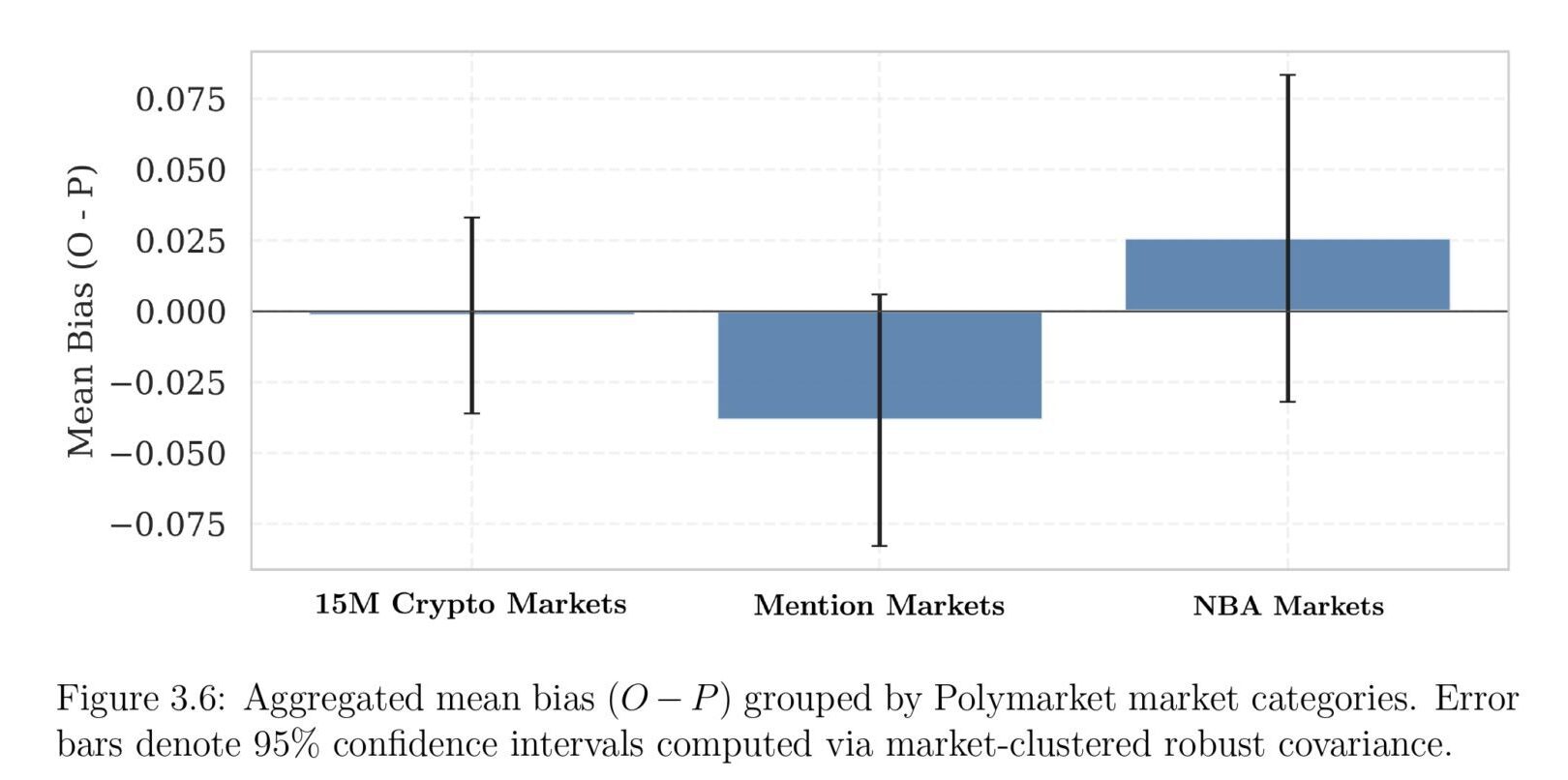
The classic favorite-longshot bias largely disappears once they control for contract lifecycle timing — what looked like that bias in “mention markets” is really a “Yes Bias,” where traders systematically overpay for the affirmative outcome.

“Whales” (the most capitalized traders) aren’t the sharpest; they tend to bleed expected value to small-order traders, trading on ideological conviction and suffering adverse selection.

The loudest participants add no edge — there’s no meaningful correlation between sentiment intensity and informational advantage, so vocal commentary is mostly noise.

Link to full article: https://papers.ssrn.com/sol3/papers.cfm?abstract_id=6322678


Other news

  • Testing an AI-Assisted Research Workflow for Multi-Asset Pullback Strategy Discovery

    This study builds a short-term mean-reversion strategy across six liquid ETFs spanning equities, fixed income, currencies, gold, and commodities (2006–2025), using a 200-day trend filter and a multi-day pullback trigger. Beyond the strategy itself — which delivers strong risk-adjusted returns while invested only ~21% of the time — the paper tests ChatGPT and Claude as…

  • Guardrails Make the Researcher: What an AI Agent Got Right (And Wrong) Replicating Nine Equity Anomalies

    An autonomous AI research agent was tasked with replicating nine published U.S. equity anomalies on clean, survivorship-free data. On a faithful build, none survive out-of-sample — and the lone apparent survivor turned out to be the agent’s own construction error. The real lesson is that an AI researcher is only as trustworthy as the guardrails…

  • How Wise is the Crowd? Bias and Edge in Prediction Markets

    Using tick-level data from Polymarket and Kalshi, this study finds the classic favorite-longshot bias is largely a ‘Yes Bias,’ that the most capitalized traders systematically underperform smaller ones, and that the most vocal participants add no informational edge. It offers a reproducible method for denoising prediction-market probabilities.